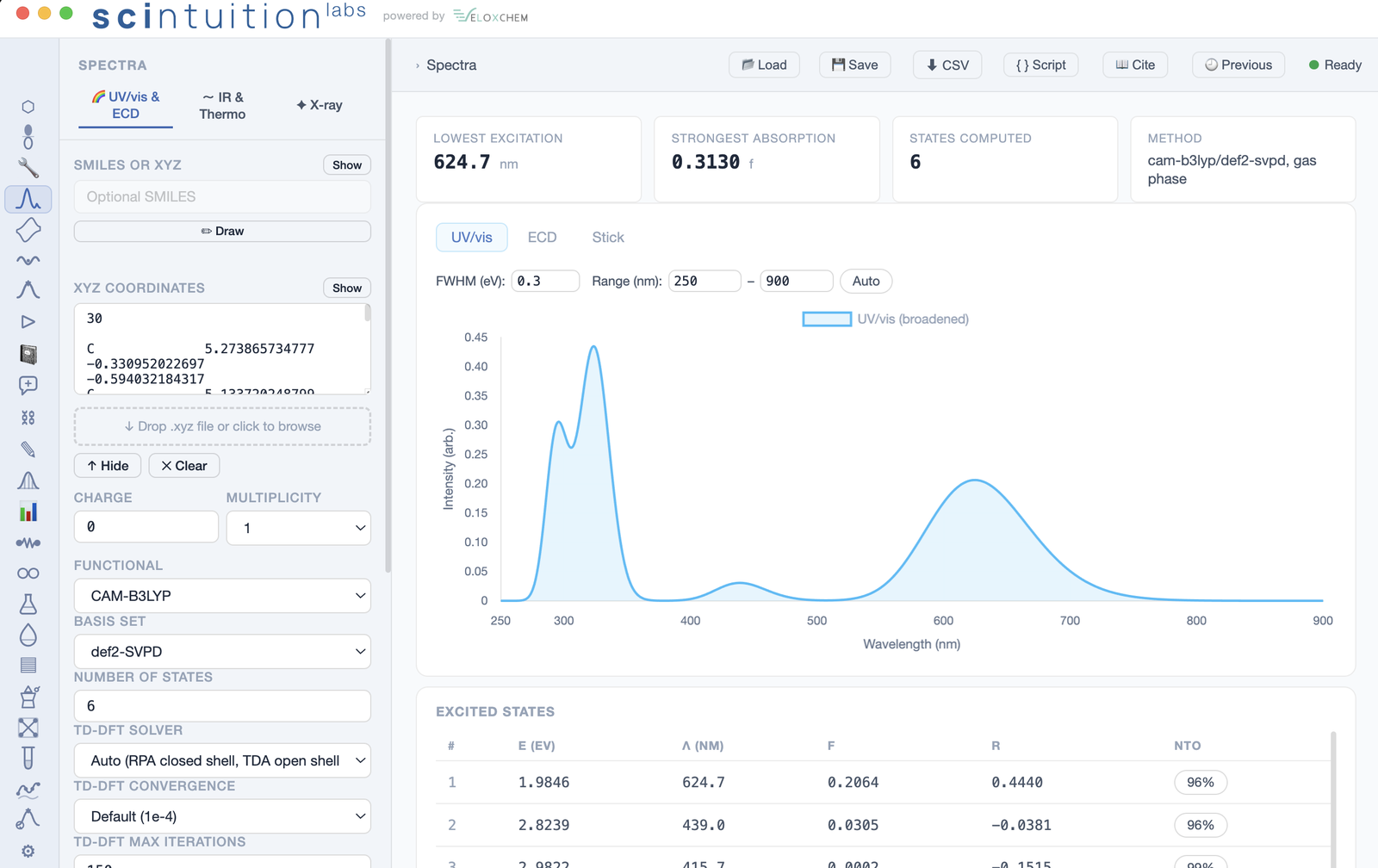
A UV/vis spectrum computed with TD-DFT, with the excited states and the weight of their dominant natural transition orbital.
The Spectra module has two tabs: UV/vis & ECD and IR & Thermo.
UV/vis and ECD
Electronic absorption spectra from time-dependent DFT (TD-DFT) in VeloxChem.
Settings
Functional: for charge-transfer or extended π systems, use a range-separated hybrid (CAM-B3LYP, ωB97X-D4). PBE0 and B3LYP are reasonable for local valence excitations.
Basis set: def2-SVPD or larger with diffuse functions gives better excitation energies than def2-SV(P).
Number of states: how many excited states to compute (default 10). Increase it if the spectrum must reach higher energies, that is, shorter wavelengths.
Broadening FWHM: width of the Gaussian put on each transition (default 0.3 eV). This sets the look of the curve only; it does not change the transitions.
TD-DFT solver: Auto uses full TD-DFT (RPA) for closed shells and the Tamm–Dancoff approximation (TDA) for open shells. Full TD-DFT and TDA force one or the other. TDA converges more reliably and is cheaper; RPA gives slightly better oscillator strengths. Excitation energies usually differ by less than 0.1 eV.
TD-DFT convergence and max iterations: the excited-state solver stops when the residual falls below the threshold (default 10-4) or after this many iterations (default 150). If it does not converge, the calculation stops with a message. Then try more iterations, the TDA solver, fewer states, or a basis without diffuse functions, before loosening the threshold to 10-3, which makes the excitation energies less precise.
Compute ECD: also computes the electronic circular dichroism spectrum. This is only meaningful for chiral molecules.
Results
the broadened spectrum, with the transitions drawn as sticks
a table of excitation energies (eV and nm) and oscillator strengths
ECD rotatory strengths, if requested
Above the chart, FWHM changes the band width and Range sets the wavelength window. Both redraw at once, with no recalculation. Auto fits the window to the states that carry at least 2 % of the strongest band’s intensity. A weak low-lying state, such as a d–d band, no longer stretches the axis into the infrared, but it is still drawn when it falls inside the window. The width is constant in energy, so a band at long wavelength looks wider in nm than the same band in the UV: 0.3 eV is about 15 nm at 250 nm and about 250 nm at 1000 nm.
natural transition orbitals (NTOs) for each state: the NTO column gives the share of the excitation carried by the leading hole → particle pair. Click it to see the hole (where the electron leaves) and the particle (where it arrives) side by side. A share near 100 % means the state is one clean orbital transition. Pairs carrying at least 5 % are kept, up to three per state. Closed-shell molecules only.
Open-shell molecules (radicals, triplets) are computed with unrestricted TD-DFT in the Tamm–Dancoff approximation (TDA) on an unrestricted ground state. TDA converges reliably for open-shell transition-metal complexes, where full TD-DFT often does not, and is cheaper. Check the spin contamination in the ground state for those. If the excited states do not converge, the calculation stops with a message saying so.
Solvation: None computes the spectrum in the gas phase. CPCM puts the ground state in the chosen solvent, and the excited states use non-equilibrium solvation: an absorption is faster than the solvent molecules can turn, so only the solvent’s electrons follow, through its optical dielectric constant (n²). SMD is not offered here, because its non-electrostatic terms have no excited-state response.
IR and thermochemistry
Vibrational frequencies from the Hessian, the second derivatives of the energy.
Settings
Method: xTB (fast), or a DFT functional. For DFT, use the same functional and basis as the optimisation that produced the structure.
Basis set and D4 dispersion
Results
the IR spectrum and the list of frequencies with intensities. Click a frequency to animate its normal mode. Above the chart: Transmission view, a frequency Scale factor, the band width (FWHM, default 20 cm⁻¹) and the wavenumber Range (empty means the full range of the modes)
thermochemistry: the zero-point energy, the enthalpy and the Gibbs free energy, in hartree and kJ/mol
Reading the frequencies
| What you see | What it means |
|---|---|
| no imaginary frequencies | a minimum |
| exactly one imaginary frequency | a transition state; check that its motion is the reaction |
| several imaginary frequencies, or small ones (below about 50 cm⁻¹) | the structure is not fully optimised: re-optimise with Tight convergence |
Imaginary frequencies are listed as negative numbers.